
Eyes on the Mountain

Penny anticipated her retirement from Norfolk Southern would give her more time with her daughter and grandchild, and allow her to finally sleep at night. She’d worked her last 18 years on the 3rd shift. ‘Now I could sleep at night, but I can’t sleep,’ she explains. Penny can’t sleep because her post-retirement job is traumatizing: she monitors the Mountain Valley Pipeline on both sides of her home.
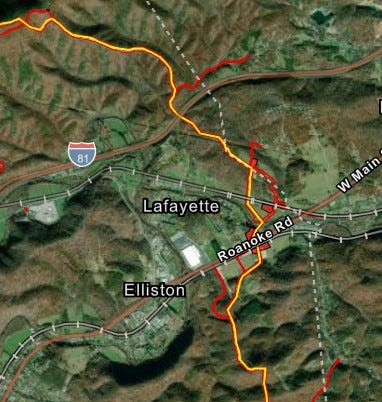
When the MVP came to her small community of Elliston/Lafayette Virginia, Penny began taking photos of the changes to the steep mountains on either side of the valley she calls home: Ft. Lewis Mountain on one side, and Poor Mountain on the other. What she saw, and the more she learned about the project sickened her.
The constant whine of chainsaws near her home in March of 2018 first got her attention. Watching evergreens felled for 2 months was Penny’s introduction to the MVP. If you know Penny even for a little while, you’ll know how important wildlife is to her. These trees provided habitat for the fox, bear, deer, hawks and rabbits she loves. Since MVP construction began, she’s seen major changes in the animals’ behavior, including leaving the woods that had become a hostile environment, and into the wide open field where they weren’t comfortable, but were safer. MVP’s blasting shocks impacted the animals. Penny has noticed changes in when migration started this year. And birds won’t go near where last year’s pipe was stored.
None of her neighbors had yet heard of the MVP even with their close proximity. Penny’s house is just 1158’ from right of way (ROW), abutting property on the ROW itself. After experiencing what she believed to be an earthquake, she found out that MVP was, without notifying the neighborhood, blasting. There was no outreach to local neighborhoods that stood to lose the most from MVP’s transgressions into their communities. One of Penny’s neighbors thought it was an oil pipeline coming through. A public meeting was held at the local high school, but only advertised on social media, which isn’t a primary news source here. The meeting discussed only generalities, not specifics like the evacuation radius, nor the definition of the blast zone. These early incidents proved to be the shape of things to come. She began meeting neighbors who were also alarmed that Elliston didn’t seem to exist to the MVP. The dust, trucks, blasting, beeping, discourtesies, all left neighbors aghast and angry.
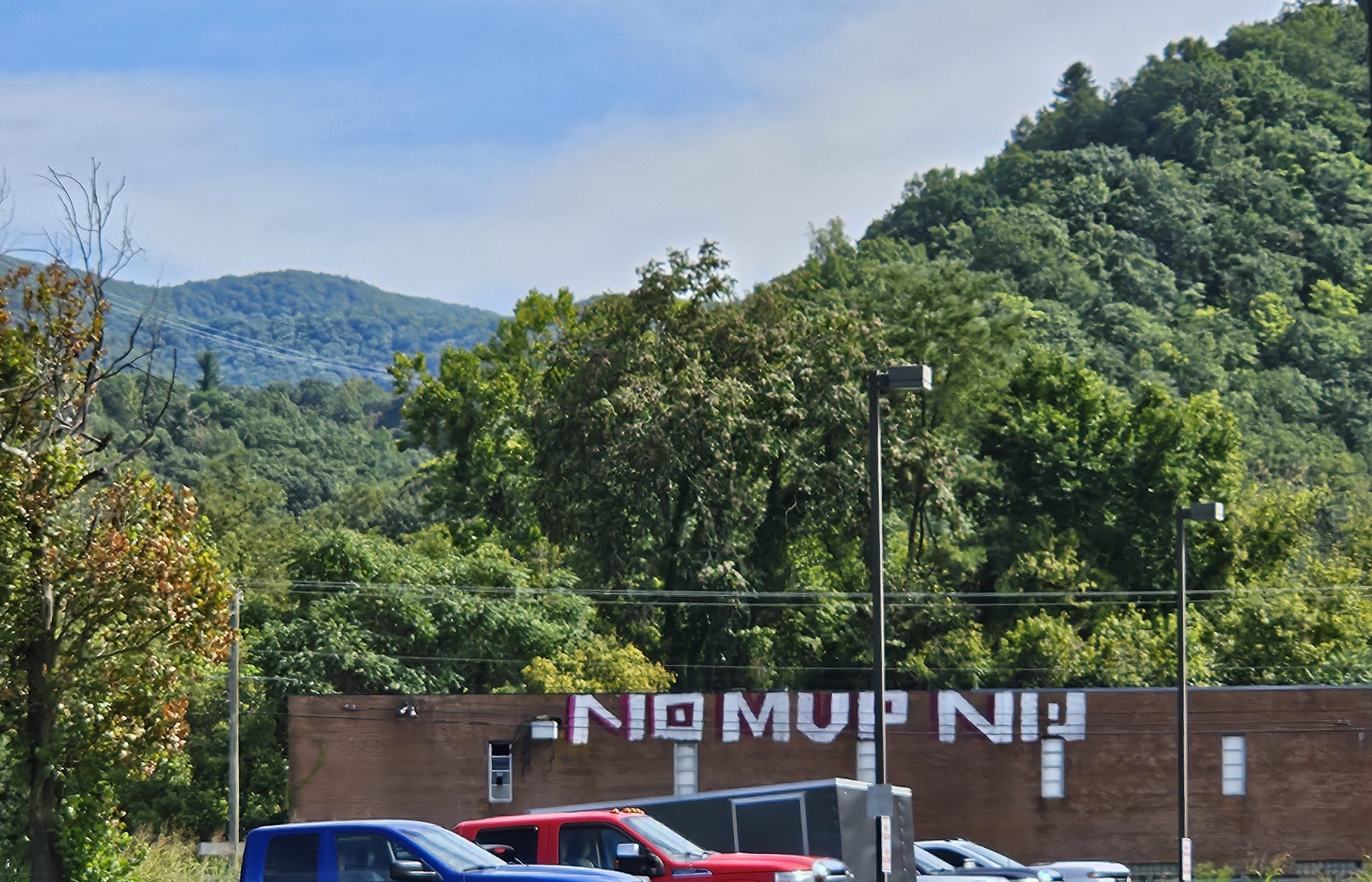
She visited the nearby Yellow Finch tree sits, curious about what it all meant. She spoke with some of the locals who had blocked the ROW in direct actions, and ‘listened to all that and local blowback. Things started to get clear. It was educational.’ Soon, Penny was observing construction activities day and night with others, and looking for better tools to observe the pipeline with.
Daily, after work, she documented what she saw. Using binoculars at first, she then borrowed a spotter scope, then an adapter for her phone and ultimately procured a tripod. A neighbor relates that it’s ‘Penny’s nature to look for a part for her phone to observe better. It comes natural for her to adapt to what’s needed.’ Penny felt called to the task, with her perfect vantage point, realizing ‘Nobody else can see this on a daily basis but me.’
With MVP’s work lights shining in her windows at night, and her direct view of Poor Mountain, she is constantly confronted with the terrible reality of the pipeline. She admits there are days she can’t get out of bed. ‘In the last year and a half, I’ve forgotten everything I wanted to do. I wanted to relax. I can’t now unless I leave and move away. I never thought my retirement would be going to devastating projects and taking pictures, but maybe that’s what I’m supposed to be doing. I can’t forget what I’ve seen. I can’t deny that it’s happening somewhere else. I can’t go back the way things were before the pipe showed up. I never wanted to know any of this crap.’
It used to be nice here. It’s easy to say the words ‘let it come through my yard’ until it comes down to it. - Penny
Gas now runs through the pipe although the public hasn’t been told what sections of the pipeline are ‘live’ or what pressure the gas is running. Penny’s house is well within the 1700’ evacuation radius on either side of the MVP, and fear of a catastrophe is primary in this community, especially after the May 1 pipe rupture that occurred during hydrostatic testing. Results from the metallurgical test on the fractured pipe were anything but reassuring, nor was the source of those results - the testing firm was hired by the MVP. Now that gas is in the pipe, Penny’s sleep is even more erratic. ‘I don’t feel good, especially when the gas started. I jump at normal noises. I’m always looking at the mountain, and wondering where my cat is, in case I need to grab her.’
When MVP, in all its reckless indifference, decided to cross Poor Mountain, the community of Elliston and Fort Lewis Mountain, they crossed Penny. She’s been in the field with eyes on MVP in fair & foul weather, good health and bad, doggedly documenting MVP’s senseless effort to defy gravity with its 42” pipe bomb. Despite MVP execs finagling our Congress, as well as our Supreme Court’s smoothing its path to ‘completion,’ the victory of the people of Appalachia lies within Penny and people like her, committed to bearing witness and telling the truth of what happened here. Her work provides evidence to state and federal authorities who still have the power to do their jobs and protect our communities from this pipeline. Penny continues to inspire us all. - Roberta Bondurant, advocate with Preserve Bent Mountain
A pipeline failure is such a likelihood to Penny that she’s moved her important documents to safety, and ruminates on where her DNA can best be extracted to prove her existence here – her hairbrush? Toothbrush?
Her dilemma is clear. She’s ‘got to find a way to figure out how to live with it, or I leave.’ However, she’s leery of owning property because it could be seized by eminent domain. Van living is looking more and more appealing.
Even with Elliston/Lafayette’s immediate proximity to the ROW, there are no evacuation plans here. The rescue squad building sits on the edge of the blast zone. (When asked if they’d had any training to deal with such a catastrophe, rescue squad members responded they hadn’t, but had heard rumor there was a valve on either side of the nearby interstate.) None of the 19 households in Penny’s neighborhood could evacuate by car, since all roads out of her neighborhood cross the pipeline at least once.
The one evacuation Penny experienced in her 12 years here was when the Roanoke River flooded. The nearby trailer park was ordered to evacuate by the fire chief circling the area in a car, his ‘evacuate now’ orders coming from a loudspeaker.
I continue to appreciate Penny's regular documentation of the building of the MVP, especially on Poor Mountain. Her videos always have excellent narration, helping all of us understand what is happening and where to look to see crucial things.
Those of us who live around Elliston appreciate honesty and timely information - neither of which come from MVP. Penny is among the handful of people who sacrifice her own free time to try to keep all of us safe. I will not be surprised if her videos and photographs help determine where problems began.
Even with just the naked eye, it's easy to see that MVP is still a long way from appropriate and safe restoration of the right of way. I wonder if they ever will along some of the worst areas. They trust the infrastructure and its installers a lot more than those of us who witnessed construction and repeated reclamation attempts. I just hope this 42” pipe never erupts like the 20” one in Texas recently. The lack of attention to obvious problems by officials throughout the process continues the longtime pattern of treating us and our part of the county as sacrificial. - Irene, community member
Penny’s former employer, Norfolk Southern, blocks the only exit out of the nearby Cove Hollow area, across Rt. 460 and at the base of Poor Mountain, for hours at a time due to train yard traffic. Waiting school buses have taken kids back to school, the waits have been so long – as long as 5.5 hours. Penny once observed an ambulance waiting in the line of cars, and advised the driver how to get state police’s attention to get the train moved. Approximately 40 houses on the dead-end of Cove Hollow Rd. are regularly blocked from exiting by these half-hourly to hourly rains.
Everyone in blast zone has a thing in their gut. Small or large, it’s always there. - Penny
The valley between the two mountains is now rife with MVP hazards. The western slope of Ft Lewis Mountain is greater than 80 degrees. Its eastern slope, although not as steep, contains a 90-degree bend in the pipeline. Within 3400’ of Penny’s house are no less than seven 90-degree angles in the pipe, each a problematic stress point on the steel.
Pipe buried close to Penny’s house in 2019 and elsewhere on the route has yet to be connected to a cathodic protection system, a promised anti-corrosion safeguard. The pipe itself has been a major concern all along the route: the steel pipe is suspected to be of inferior quality, was exposed to the elements for years beyond industry recommendations, was not re-coated in an optimal factory setting, nor has the cathodic protection system that helps prevent corrosion been completely hooked up and other agreed-on tests been performed.
If it wasn’t for Penny’s extraordinary ability to visually and verbally document the crimes in real time, there would be no proof of MVP’s inability to conquer Poor Mountain. With that proof comes the tenuous hope of a major delay in full-on, if any, transmission of gas through the pipeline. - MBCoffey
The present and future harms the MVP promises to the Elliston/Lafayette community will increase the area’s already high pollution load. Air pollution here comes from many sources: the nearby interstate I-81, the 4-lane Route 460, the NS railroad carrying coal in its open cars, and traffic to a nearby landfill. Add pollution that will be constantly generated from a massive 42” fracked gas pipeline and its accompanying gas gate station, and yet another environmental injustice debacle is created. Virginia code defines an EJ community as majority low income and community of color. This area is both, and quantified by a 2022 door-to-door survey, modeled on the Union Hill survey that showed Dominion Energy’s erasure of that community at the site of the Atlantic Coast Pipeline’s only planned compressor station in Virginia – an erasure that was in large part responsible for the ultimate cancellation of the ACP.
I want to leave, but don’t know where to go. Don’t want to live thinking ‘is this it?’ I was taught to ask what’s proposed and what’s pending like people here. No one told the newcomers. Where is there to go? - Penny
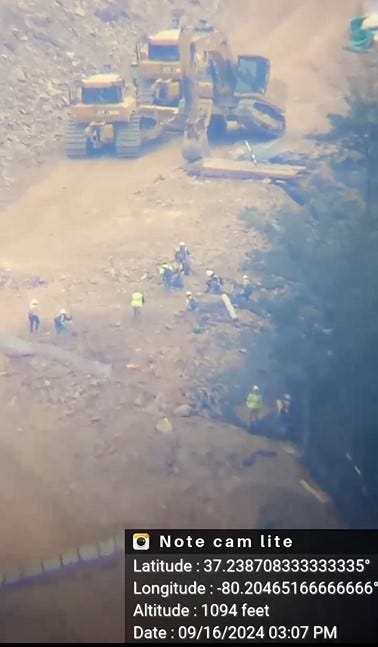
Poor Mountain continues to be a busy work site, even though the pipeline went in service mid-June. Penny has documented many instances of heavy equipment crossing or parked directly atop the buried pipe, although MVP limits landowner traffic on their easements because of the known risk of harming the pipe, even if no gas is in it.
Recently, Penny observed an excavator dumping rock onto the near-vertical ROW on Poor Mountain. Rocks began rolling off the ROW as she recorded, into woods on private property. Penny felt for the battered trees bearing the brunt of the rolling rocks. She worried about the animals in those woods, suddenly invaded. She wondered whether the electric company whose high tension wire structures are just downhill from the careening rocks and whether they knew about the potential danger of the flying rocks. She calculates tons of soil have been lost off the ROW, as well as falling fences and rocks.
Poor Mountain is vertical. They think the rock stay will stay put? They’re dumping rock in piles on the ROW - is it a filtration system?’ Who’s going to take care of that when stuff starts sliding? They’re parking on top of live pipe. Little dump trucks of dirt going up mountain. - Penny
Who will maintain the ROW after MVP leaves is a question many wonder about. Gravity will prevail, and these soils are known to be highly erodible. Who will pick up what slides off the nearly vertical slope? Penny predicts ‘restoration’ will be impossible. ‘You’ll never know we were here’ was an oft-repeated MVP reassurance before construction began, just another marketing tool. But restoration is a condition of MVP completion, requiring vegetation on the ROWs. Penny has observed MVP ‘can’t grow anything (on the ROW) besides crabgrass & Johnson grass. Seeds sown died in the drought.’ Penny’s prediction: ‘ We’ll see exposed pipe on Poor Mountain. I think it will slide that bad. I’ve seen it erode.’
When she’s not taking pictures of the silt and plastic attempts to hold up a mountain stripped of its roots and stones, or sussing out explanations of cathodic protection or other shrouded mysteries around pipeline construction, she’s documenting the many beloved critters with whom she shares time in the field — herons and minks at the river, a baby bear cavorting on a hay bale, a doe nursing her fawn, and much more. Her documentation shows the dichotomy of horror mixed with wonder.
During the thirteen years I lived in EastMont on the banks of the Roanoke River, I didn’t know Penny. Our friendship has since been forged by a shared love for these sacred mountains and opposition to this destructive and needless boondoggle. Penny is a self-educated and fiercely dedicated pipeline opponent. She has a tender heart and an enormous amount of love for all the wonderful non-human creatures who are also heavily and disastrously impacted by the MVP. She is an example of Appalachian strength and perseverance, and has become a lifelong friend. - AS
Hiking the woods here, she’s come upon unpleasant surprises. There are no porta-johns on Poor Mountain, so workers leave the ROW to do their necessary business on adjacent private property, as well as litter the area with sandwich wrappings and toilet paper. As a long-time union member, Penny feels the workers’ union has failed them by not ensuring means for proper hygiene. ‘What else happens on the ROW when MVP thinks it’s out of view of the public? They had nothing up there. That right of way is their litter box. Don’t go on someone else’s land.’
I admire Penny for the vital role she’s played in watching MVP. Her documentation shows we can’t hold them to their word. This (Poor) mountain is still horrible after 4 months (of continuous work after calling itself ‘mechanically complete’). It’s taken a huge emotional and physical toll. She keeps me on track. Penny’s keeping me motivated. She’s having a ripple effect of love-building for the Elliston Community.
We were followed into a trailer park by police and workers for doing nothing but observing. There’s a concern for safety, but it’s also important to be able to speak your truth. If you can’t do that, we’re already giving up. So many rights are being threatened and so many voices are being silenced by SLAPPs (suits), that has an effect on locals.
I’m skeptical of everyone. I’m not trusting any government agencies after this pipeline. Who do we trust at this point? Each other. A majority of the community thinks it (the MVP) is stupid. A horrible idea. A lot of people say to me, ‘you’re still fighting? Big money always wins.’ That’s the overall sentiment. - Crystal
The MVP has left the community in the dark about many issues. The community doesn’t know if there’s gas running through the entire pipeline, although MVP has touted that it is now selling the gas. At what capacity is the pipeline running? Why wasn’t the yellow pipe wrap observed in more visible work areas used throughout construction? Where will the massive quantity of polluted, likely toxic water that was used for hydro-testing, and only gets increasingly foul, go? Should that pool liner rupture (like the first one did), houses downhill could get washed away – it’s that immense.
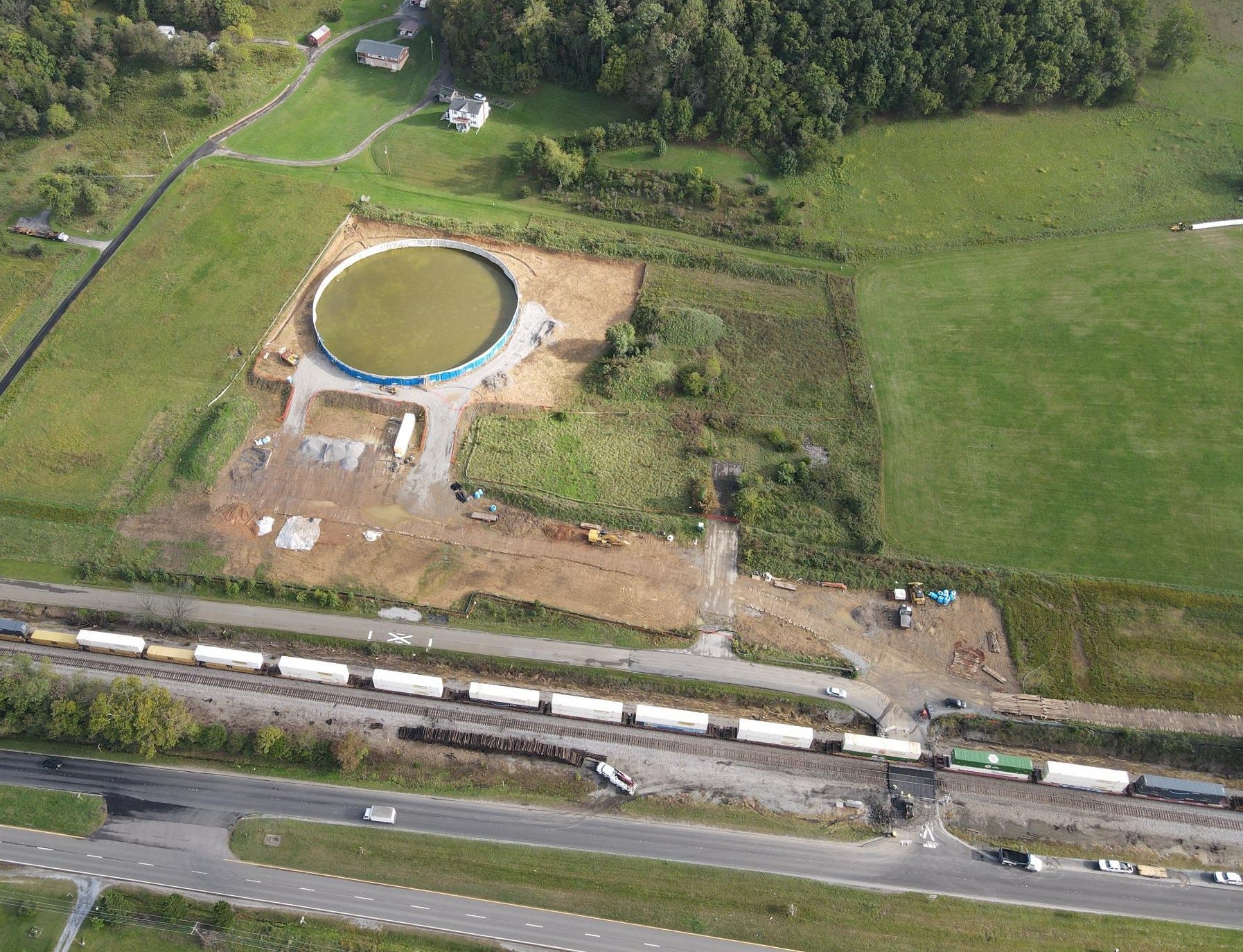
As long as the MVP is operational, the trauma of this ongoing crime scene will assure Penny and the surrounding communities get no sleep.
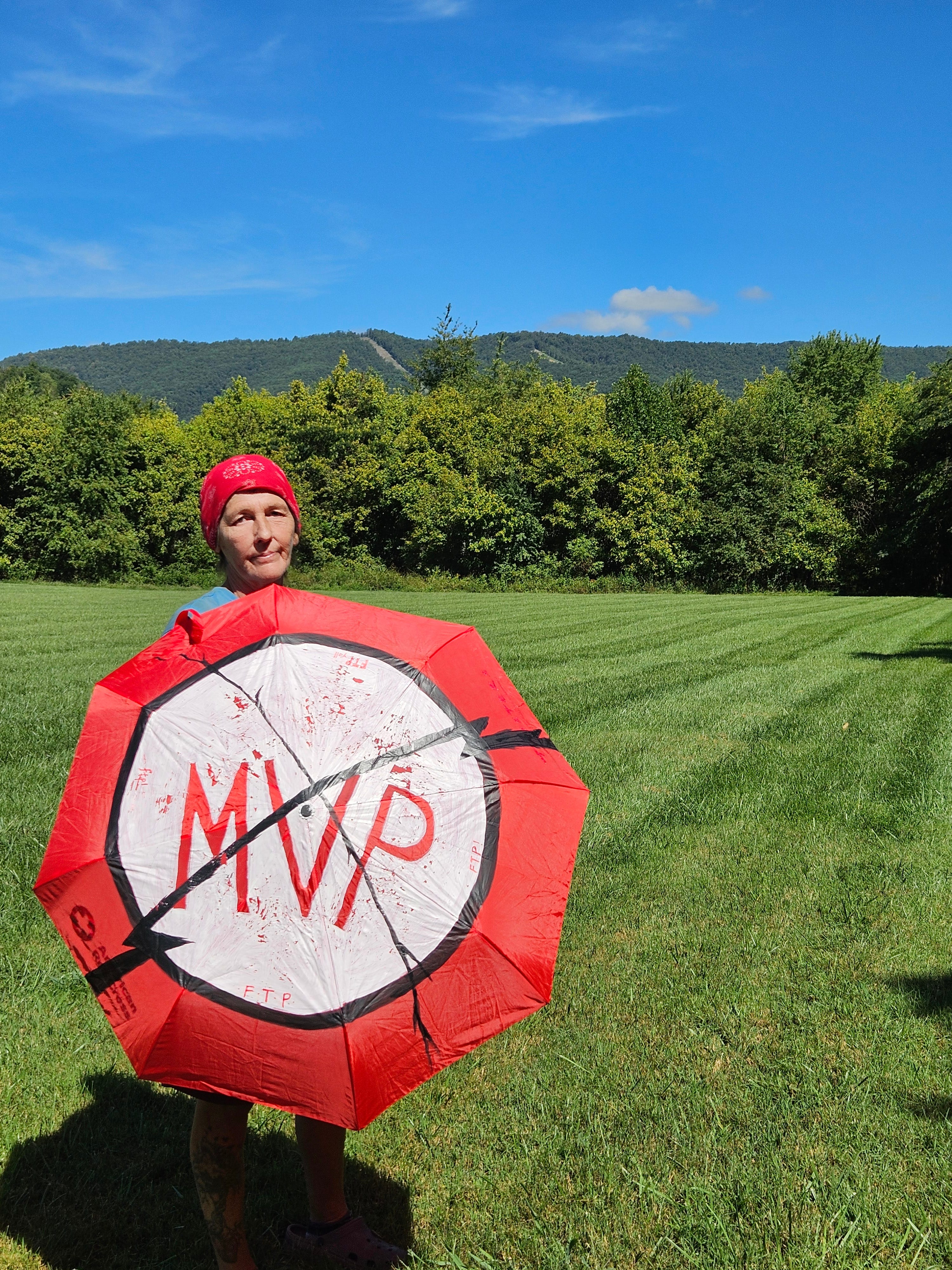
The recent hurricane disasters and the Mountain Valley Pipeline have parallels: both inflict government- and industry- wrought harms on communities. By deferring to moneyed interests and business-as-usual instead of moving away from practices that are killing the planet, they prove their intent of putting profit first. Communities have learned that they can only rely on each other to protect themselves and their welfare. Please continue to give to community-based and mutual aid disaster relief efforts!
All photos courtesy Penny for Mountain Valley Watch.
Please donate to the legal defense fund for pipeline fighters: bit.ly/AppLegalDefense. Protectors still face expensive criminal and civil lawsuits, and there exist at least 12 SLAPP suits with more than 48 people charged with various offenses including conspiracy and damages of up to $4.3 million. These suits are intended to create hardships in paying for legal defense, and to intimidate and instill fear.
Thank goodness for people like Penny who are willing to watch closely and document what is going on! May there come a time when such documentation is no longer necessary in this world, and that we all work together for the good of all of us, humans, animals, plants, etc.
One question: on the map, is the MVP the red and yellow line?